
The Child Who Never Stopped Playing: What Childhood Play Reveals About Who You Really Are
- May 3
- 3 min read
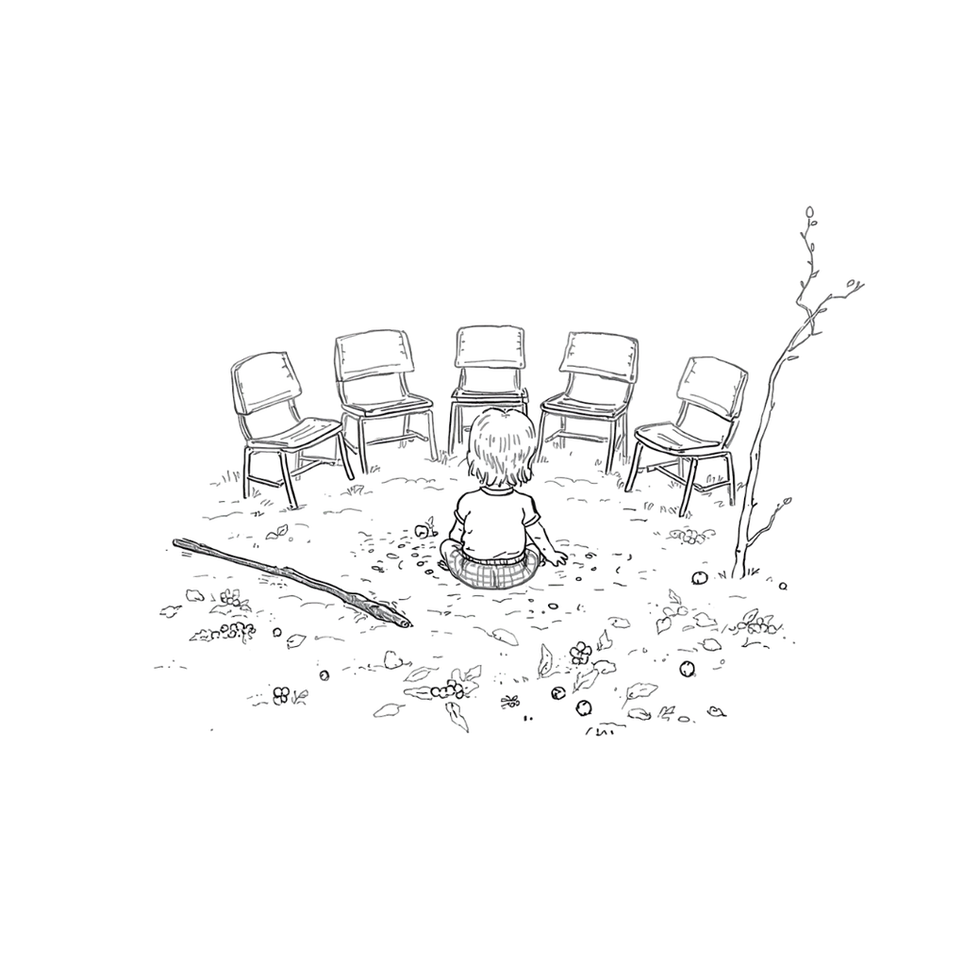
I made mud pies until I was probably too old to make mud pies.
I set up imaginary classrooms in my backyard with empty chairs, and a stick for a pointer, and lessons nobody asked for. I picked berries and collected critters and rode my bike through the woods alone for hours, not because I had to, not because there was nothing else to do, but because something in me needed to be doing something with my hands that felt like it was for someone.
That last part took me a long time to understand.
Because from the outside, it probably looked like a lonely kid making do. A child entertaining herself in the absence of something better. And I won't pretend the world I grew up in was particularly interested in what I was building out there in the dirt.
But here's what I know now that I couldn't have told you then.
I was never actually playing alone.
Every mud pie was meant to be shared. Every lesson in that imaginary classroom had students in it, even when the chairs were empty. The berries were always more beautiful when I could show someone where I found them. The critters mattered more when there was someone to release them with.
I wasn't a lonely child making do.
I was a child who already knew her purpose, who just hadn't found her people yet.
There's a difference. And it took me most of my adult life to see it clearly enough to say it out loud.
We have this idea that childhood play is preparation. That's practice for the real thing. That the mud pies are just mud pies until you grow up and do something that actually counts. The world is very efficient at delivering that message. It arrives in the voice of a parent who says, "Be practical". A teacher who says, "Stop daydreaming". A culture that measures worth in productivity and asks, "What are you going to do with that?" With a tone that already knows the answer it wants.
And somewhere in there, most of us get interrupted.
We stop making the things we used to make. Not because we decided to. Not because we outgrew them. But because someone communicated, directly or otherwise, that what we were building out there in the dirt didn't count.
So we put it down.
And we pick up whatever counts instead.
And we spend the next several decades performing a version of ourselves that was assembled from other people's ideas about what we were supposed to become, while the child who knew something true about us just goes quiet.
She doesn't disappear. That's the thing nobody tells you.
She just goes quiet.
And every once in a while, something happens... a song comes on, or you watch a child playing alone, and something in your chest does a thing, or you find yourself standing in a garden with your hands in the dirt feeling more like yourself than you have in years, and you get a glimpse of her.
The one who was out there in the backyard with the empty chairs, the stick pointer, and the lessons nobody asked for.
The one who already knew.
I think about the adults I've sat with over the years. The ones who came in lost, stuck, or performing a version of themselves that didn't quite fit. And what I've noticed, what I keep noticing, is that underneath the adult story, there is almost always an interrupted child. Someone who was making something true and got told to stop.
Who had a blueprint and was handed someone else's instead.
The work is almost never about adding something new.
It's about finding the way back to what was already there.
So I want to ask you something, and I want you to actually sit with it rather than answering too quickly.
What did you make when you were small that you haven't made in a long time?
Not what you were supposed to make. Not what looked good, counted, or impressed anyone. What did you actually do when you had dirt, time, and no one telling you who to be?
Because I don't think it was random. I don't think any of it was random.
I think it was the blueprint.
And I think part of you has known that all along, which is exactly why it still hurts a little when you think about it.
There's room at the table if you want to find your way back.
Thank you for reading. If this piece resonated with you and you’d like support in untangling these patterns in your own life, I offer a free 30-minute consultation. It’s a gentle space to talk, reflect, and see whether working together feels like a good fit. You can book a time through my website whenever you’re ready.


Comments